A blind veteran from North Wales is set to march at the Cenotaph in London for the first time this Remembrance Sunday (8/11) with the charity Blind Veterans UK.
Ian Murray, 52 and from Rhyl, will be marching at the Cenotaph as part of the national Remembrance Sunday commemorations with over 40 other blind veterans supported by Blind Veterans UK, the national charity for vision-impaired ex-Service men and women.
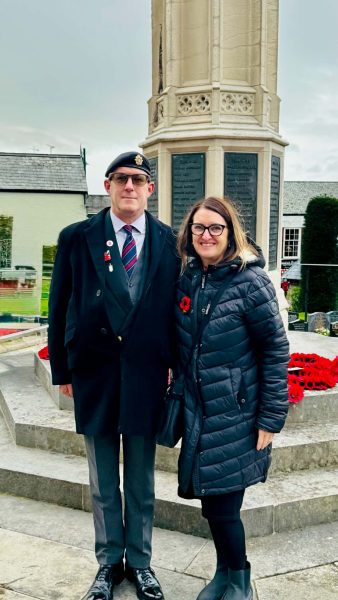
Ian joined the Army in 1991 at the age of 15 as a Junior Leader in the Queen’s Dragoon Guards. Coming from a military family, joining the Armed Services was always his plan. After a serious leg break, Ian was discharged but was determined to re-join and eventually re-enlisted into the Royal Welsh Fusiliers, later transferring to the Royal Logistics Corps.
During his Army career, Ian served in Bosnia, Kosovo, Northern Ireland and Afghanistan. He says:
“It was more like a family than a job. I left in 2002 at 27-years-old, I’d done my time and I’d seen a lot which eventually became too much. The things I saw are locked away in the back of my head, but I do get flashbacks. It helps to talk to those who served with me and experienced the same things.”
Following his Army career, Ian’s life took him down an interesting path which led him to become a chainsaw sculpture artist, designing and crafting works of art out of tree trunks. He says: “I got to travel the world; I was commissioned by Hollywood stars to create things like a life size Darth Vader; the late Prince Phillip bought three of my pieces to display in the gardens at Sandringham Palace. This was my life but just three years ago while at work one day, I suddenly felt like I was a bottle of pop that had been shaken. I knew something wasn’t right and I drove to my doctor who sent me straight to the hospital. I’d had a stroke and it took my eyesight.
“It was like I’d been kicked really hard. My sight was my job; I couldn’t be an artist without it. My independence was ripped away from me; I could no longer jump in my car or motorcycle and go. I now need to plan in advance for getting from A to B and I rely on others which is not in a soldier’s nature. I didn’t have great thoughts to begin with; I suffered with depression and anxiety and was housebound for eight months, too scared to leave my home, but I knew I couldn’t carry on like that.”
Ian was already aware of Blind Veterans UK as he had showcased his carving to other blind veterans before his own sight loss. He says:
“I taught blind veterans how to carve wood, and this has helped me regain a positive mentality. If I could teach blind veterans who had never carved before, then in the future I can hopefully find a way to once again carve myself.
“Never for one moment did I think it would be me being a blind veteran and reaching out to the charity for support. A friend of mine encouraged me to get in touch telling me it was now my time to be helped.”
Ian began receiving support from Blind Veterans UK 11 months ago. He says:
“The charity has given me a new lease of life, being among other blind veterans is a safe space where everyone is in the same boat. My first visit to the centre, I took part in an adrenaline week which included climbing and paddleboarding. It’s given me back the confidence to say I can do it, I just need to find another way and if I mess up, I have the staff and my fellow veterans spurring me on to try again.”
Ian will be marching with his fellow blind veterans at the Cenotaph this Remembrance Sunday.
He says:
“My grandad was in the Grenadier Guards; he died while I was on my first tour. When I returned, I put my first medal on his graveside and it’s still there now. I made a promise to him that I would march at the cenotaph and if I say I’m doing something, then I do it. It’ll mean so much to me to be there. I will be thinking of my grandad and of a couple of mates I lost while on tour.
“Remembrance will take me back to what was not the best of times, but I need to remember that I’m still here and I can show others what can still be achieved with sight loss.”
Chief Executive of Blind Veterans UK, Adrian Bell, says:
“Every November, we honour those who served our country, remembering their sense of duty, sacrifice and service. This Remembrance Sunday, I am proud to march alongside our blind veterans as we remember those who gave their lives in service to our country and reflect on the contribution of all who have served.
“This year also marks a number of significant anniversaries, including 35 years since the end of Operation Desert Storm, the liberation of Kuwait by Coalition Forces, and 15 years since the end of Operation Telic, UK military operations in Iraq. These milestones remind us of the enduring impact of military service and the importance of ensuring veterans receive the support they need long after their service has ended.”
Ian’s story forms part of Blind Veterans UK’s 2026 Remembrance campaign, ‘When blind veterans can’t march alone, we march with them.’
For many ex-Service men and women living with sight loss, taking part in acts of Remembrance remains deeply important. Yet losing one’s sight can bring significant challenges to independence, mobility and confidence. Blind Veterans UK stands with them throughout their journey, supporting them to take part in Remembrance and rebuilding their lives after sight loss through rehabilitation, training, equipment and emotional support.
Blind Veterans UK supports thousands of blind veterans like Ian, but knows there are many thousands more who could benefit from its support.
If you, or someone you know, served in the Armed Forces, including National Service, and are now struggling with sight loss, then please get in touch. Call 0800 389 7979 or visit blindveterans.org.uk/apply.