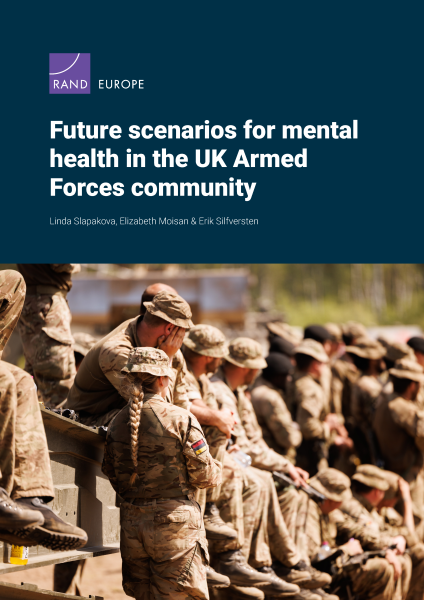
The new research by RAND Europe with Combat Stress and funded by FiMT explores how the future Defence landscape and wider societal changes could impact mental health support needs of the Armed Forces community over the next 20 years.
Organisations that support the mental health of the Armed Forces community need to constantly adapt to changing support needs and evolving interventions. This research provides a practical tool to help organisations test whether their current strategies, partnerships and ways of working are resilient enough for the future.
The report sets out five plausible future scenarios that organisations can use to test the resilience and adaptability of their strategies, to ensure they can meet evolving need in the future.
Future scenarios
The report authors used a structured scenario planning process with engagement from experts and specialists to explore how five plausible scenarios might impact the Armed Forces community and wider support sector.
The scenarios are not predictions, but rather show how different possible uncertainties, such as workforce shortages, operational tempo, public health crises, or changes in technology would shape support needs and impact mental health provision.
For instance, one scenario considers the implications of how a shrinking-working age population and relative global peace could change mental health support needs, while other scenarios explore pressures linked to climate change and public health crises. The report also considers the impact on mental health needs of increased global conflict and UK operational involvement. Importantly these scenarios are not mutually exclusive and may in fact happen simultaneously or in quick succession from one to another.
The central message of the report is that charities should not plan based on a single expected future. Instead, organisations should use the scenarios to examine their assumptions, identify potential vulnerabilities, and consider how their services, partnerships and operating models may need to adapt.
The report also highlights that future mental health needs will be shaped by a broad range of factors such as inequality, housing needs, employment, and social isolation. A holistic understanding of factors that impact mental health will help ensure support matches the future needs of the Armed Forces community.
The full report contains a breakdown of the ten uncertainties and five scenarios and their implications for charity sector mental health support for the Armed Forces community.
Linda Slapakova, Lead Author, RAND Europe said,
“The Armed Forces support sector is facing significant uncertainty around the future demands of military service and how support needs of the Armed Forces community might evolve in this context. This research clearly demonstrates the value of futures and foresight techniques in helping the sector prepare and build resilience to future risks and disruptions.”
Alan Friggieri, Director of Strategy and Communications, Combat Stress said,
“For more than a century, Combat Stress has evolved to meet the changing needs of the Armed Forces community, and we are determined to continue leading that evolution to help shape the future of mental health support for those who serve.
“While the future is difficult to predict, we know it will bring new pressures from technological and societal change to global instability. As the roles, demands and landscape of the Armed Forces shift accordingly, so too must our approach.
“Our research into what may lie ahead is already informing our long‑term strategy, helping us build the resilience, responsiveness and partnerships needed to ensure veterans and their families can continue to access the best possible mental health support, no matter how the world changes around them.”
Michelle Alston, Chief Executive of Forces in Mind Trust said,
“Charities are a cornerstone of mental health support to the Armed Forces community. This report gives charities, policymakers and service providers a way to think through different pressures on the mental health of the Armed Forces community to test that existing strategies and policies are fit for purpose. This report can hopefully be a useful toolkit to help the sector adapt and improve support during the next 20 years.”